
How MEZO Emissions Work
Learn how Mezo’s emission schedule works and how MEZO issuance bootstraps liquidity, validator security, and ecosystem growth while veBTC holders earn BTC-denominated fees.
Bitcoiners judge a system by what it returns in bitcoin. Mezo is built around that standard.
veBTC holders receive BTC-denominated revenue from bridging and chain fees as passive yield. veBTC holders can also vote on gauges, claiming swap fees and MUSD revenue that those gauges collect. The fee system is what turns locked BTC into more BTC.
Emissions, sometimes called the emission curve or emission schedule, are the rate at which a protocol creates and releases new tokens. On Mezo, emissions (MEZO) are the coordination budget around that fee system. They pay for incentives and early ecosystem support needed to build durable fee flows. BTC returns stay tied to those flows.
The challenge of creating an efficient emissions system is calibration. If MEZO inflates too aggressively, early participants are diluted. If it tapers too sharply, the flywheel does not have a chance to kick in. The MEZO schedule strikes a balance between both.
The emission schedule
MEZO has a genesis supply of 1,000,000,000 tokens and a circulating supply of 500,000,000 tokens.
| Phase | Timeline | Emission Rate |
|---|---|---|
| Bootstrap | Years 0–2 | 25% → 12.5% |
| Growth | Years 2–4 | 12.5% → 6.25% |
| Maturity | Years 4–8 | 6.25% → 2% |
| Perpetuity | Years 8+ | 2% (terminal) |
Emissions in any given epoch are fixed by this curve. Mezo runs in 7-day epochs, with each epoch beginning on Thursday at 00:00 UTC. When a gauge wants more emissions, it competes within the fixed budget against every other gauge by posting incentives.
Early emissions have to concentrate heavily enough to bootstrap BTC locks and LP positions. The middle has to decay in a pattern that signals long-term supply discipline. The tail has to stabilize at a positive rate so validators, LPs, and grant recipients are funded on an infinite horizon. The MEZO emission schedule accounts for all three.
Rebase and reward
Before emissions reach the gauge system, they split into two pots. One pot is the rebase, paid to veMEZO lockers as protection against dilution. The other pot is the reward, which flows through a splitter tree to validators, LPs, and ecosystem gauges. The splitter tree and gauge mechanics are covered in How Gauges and Splitters Work on Mezo. This section covers how the rebase is computed.
Mezo computes the rebase from a lock ratio. Let S_total be total MEZO supply and S_ve be MEZO currently locked as veMEZO. Then,
R_liquid = (S_total - S_ve) / S_total
E_rebase = E_t × (R_liquid)² × 0.5
When very little MEZO is locked, R_liquid approaches 1 and the rebase approaches 50% of weekly emissions. Early lockers receive an outsized share. This is deliberate. A new chain needs an incentive to get MEZO into veMEZO quickly, and the square term concentrates the reward on the earliest committed capital.
As more MEZO gets locked, R_liquid falls. The square term makes the rebase fall faster than linearly. At 50% locked, the rebase is 12.5% of emissions. At 70% locked, the rebase is 4.5%. The rest flows to the reward branch. Over time, as the rebase reduces, rewards grow.
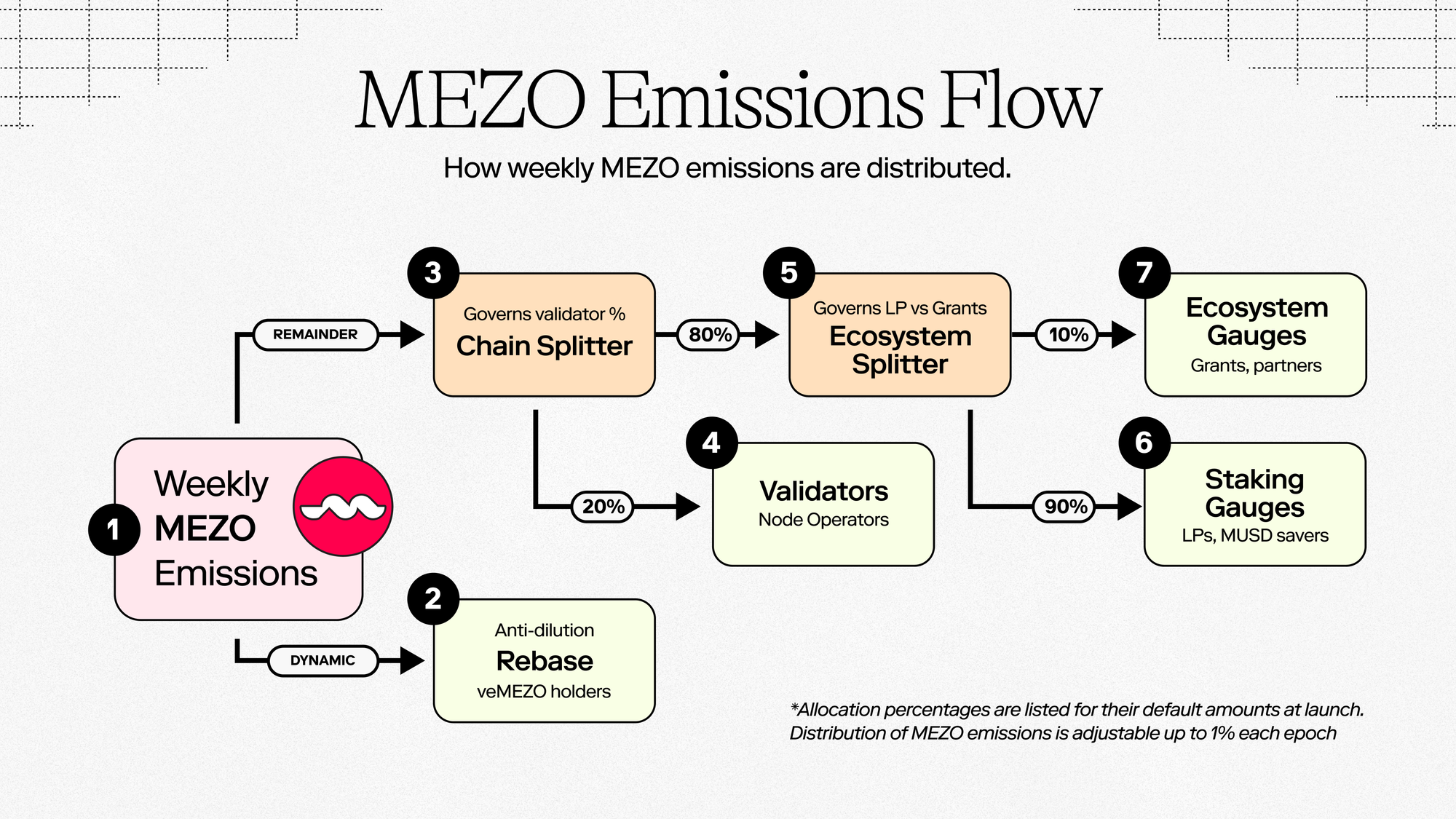
Mezo's rebase differs from other ve-systems in that veMEZO rebases are allocated from a fixed weekly emission budget, not minted on top of it as additional supply. That keeps the supply schedule fixed and addresses dilution through allocation, rather than through expanding total issuance.
Get Started
Every Thursday, veBTC holders are paid in BTC from chain fees. How Gauges and Splitters Work on Mezo covers how reward emissions complement that flow. Lock BTC into veBTC to start earning. Votes for the next epoch close on Thursday 00:00 UTC.
→ The full emission spec is in the Mezo Earn whitepaper.
→ Onboarding guides and product details are at the Mezo docs.
→ How Gauges and Splitters Work on Mezo.



Comments ()