How veMEZO works
Learn what veMEZO is and how it can be used to optimize your Bitcoin-native yield.


Every BTC yield source asks you to trust a counterparty, a token incentive model, or both.
veMEZO is how Mezo Earn breaks that pattern.
Mezo Earn: Quick Recap
TL;DR: Mezo Earn is the economic engine behind the Mezo chain. It coordinates how value flows between BTC holders, liquidity providers, validators, and the protocol.
The system captures revenue from three sources: loan interest on MUSD debt, swap fees on BTC and MUSD liquidity pools, and transaction fees on the chain. These are fees paid by borrowers and traders using the network.
Two tokens drive the system:
→ veBTC — Lock BTC, receive base voting power, and a claim on protocol fees.
→ veMEZO — Lock MEZO, multiply fees earned on your veBTC position.
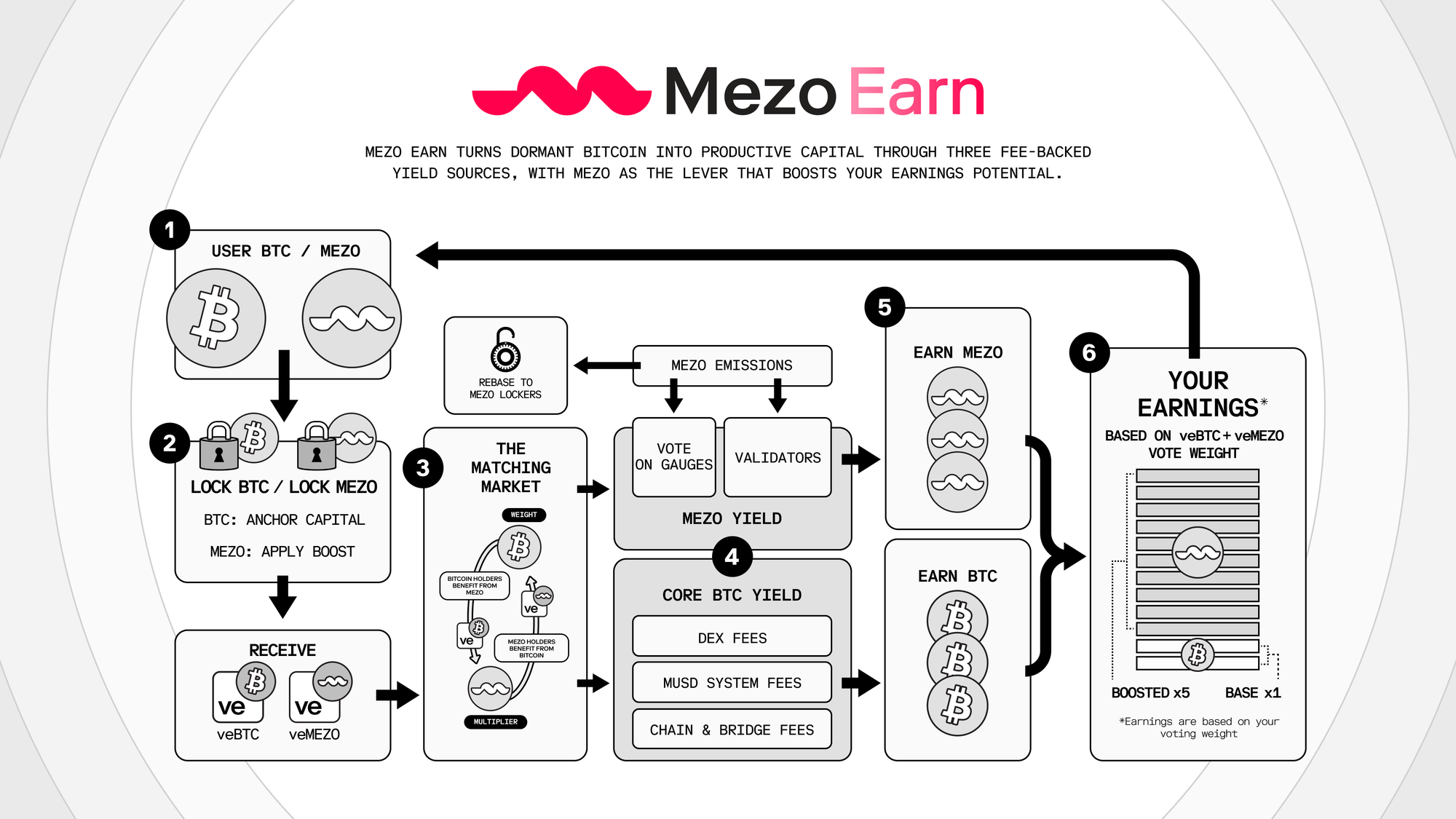
For a full Mezo Earn explainer, read the Mezo Earn whitepaper.
What is veMEZO?
TL;DR: veMEZO is locked MEZO.
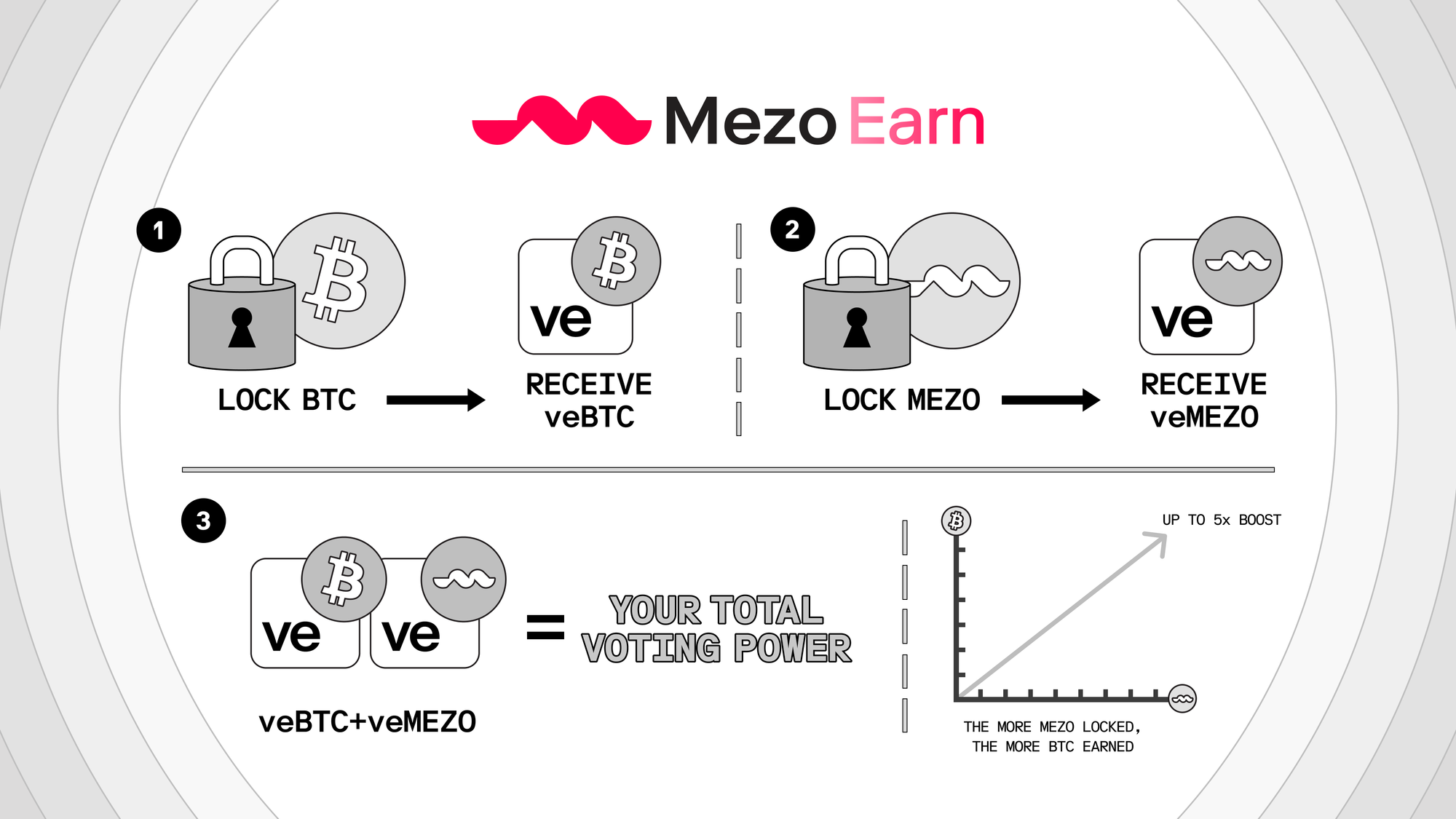
When a user locks their MEZO position for a chosen duration, they receive veMEZO, a time-weighted escrowed position represented as an NFT. The longer the lock, the greater the voting weight. Lock duration ranges from one week to four years. As time passes, that weight decays linearly.
veMEZO exists to amplify veBTC. It scales a BTC holder's voting weight and their share of protocol fee revenue up to 5x. It carries no independent voting power. It cannot direct emissions, claim fees, or govern the protocol on its own. However, veMEZO is also productive on its own. veMEZO holders can direct their votes to any veBTC gauge and collect the incentives that BTC holders post.
In many token systems, the native asset gradually becomes "the thing" the entire mechanism serves. The collateral, users, and application layer all end up orbiting the token. Mezo is trying to avoid that failure mode. BTC remains the anchor asset. veMEZO exists to make BTC-based participation more expressive, more competitive, and more economically efficient.
How veBTC and veMEZO combine
Every veBTC position starts at a 1x multiplier. Lock BTC, receive base voting weight, earn a share of bridging and chain fees. No MEZO required. This is the base case. As stated earlier, veMEZO scales that voting weight up to 5x.
The boost depends on a user's relative share of the total veBTC pool and relative share of the total veMEZO pool. When their share of veMEZO is proportionally as large as their share of veBTC, the user reaches the cap.
Two properties define this mechanism:
- The cap is hard. No combination of BTC and MEZO produces a multiplier above 5x. The system rewards proportional commitment, not accumulation.
- The boost scales inversely with BTC position size. A large BTC holder needs a proportionally larger share of veMEZO to reach the same multiplier that a smaller holder achieves with less. Large positions cannot dominate governance without proportional MEZO commitment.
In simpler terms: if you own 10% of all veBTC, you need 10% of all veMEZO to hit max boost. A participant with 1% of veBTC only needs 1% of veMEZO. The formula enforces parity.
The Matching Market
In most ve-systems, boosting is a side-effect of holding two assets at the same time. Users must compute their own optimal position across LP tokens and governance tokens. Mezo Earn makes the pairing explicit.
Every veBTC NFT receives its own gauge. veMEZO holders vote on these gauges. The more veMEZO weight directed at a specific veBTC gauge, the higher that position's boost.
This creates a two-sided market:
→ BTC-heavy, MEZO-light: Post incentives on your veBTC gauge to attract veMEZO votes. Boost becomes something you pay for rather than something you must self-optimize into.
→ MEZO-heavy, BTC-light: Survey the available veBTC gauges, find those with the best incentive yield, allocate veMEZO votes accordingly. MEZO converts into a claim on BTC-derived fee flows without requiring proportional BTC exposure.
Boost becomes a permissionless, tradeable service.
When the matching market is thin, the system still works. A veBTC position with zero veMEZO votes operates at base weight. When the market is active, it equilibrates. Over-incentivized gauges attract more veMEZO votes until the marginal yield per unit of veMEZO matches alternatives. Price discovery happens at the gauge level, every epoch.
A community implementation of the matching market is already live in production. A step-by-step guide is available here.
The Long Game
The most important question we asked ourselves when building Mezo was: how do you build Bitcoin-native finance around security, verifiability, and real economic demand? Locked MEZO, or veMEZO, is one answer to that question.
veMEZO gives BTC holders a mechanism to increase their pro-rata share of protocol fee revenue. The more capital locked and the longer the lock, the larger the claim on fees the network generates.
BTC remains the anchor. veMEZO makes the system easier to coordinate and scale around it.
Learn more about Mezo Earn
→ Mechanics of veBTC: How veBTC works
→ Where the yield comes from: Yield source breakdown
→ Full system design: Mezo Earn Whitepaper