
How Gauges and Splitters Work on Mezo
Learn how Mezo gauges and splitters route weekly MEZO emissions, how veBTC votes direct rewards and fees, and how validators, liquidity, and MUSD savings compete for support each epoch.
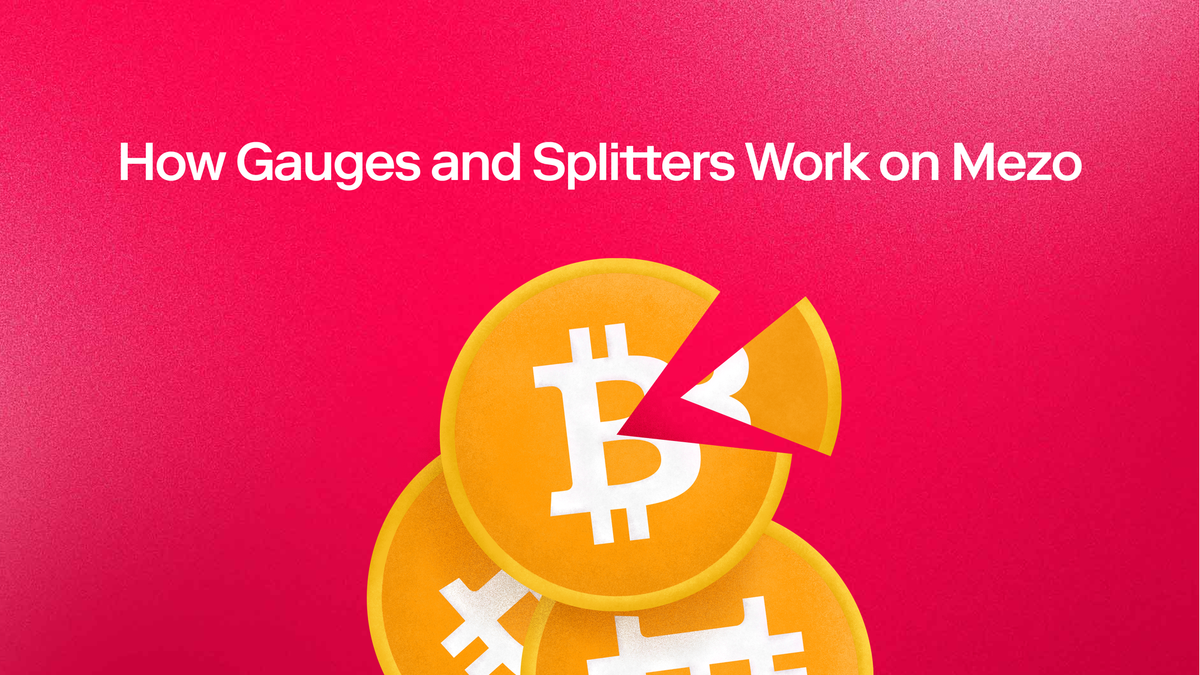
Mezo's gauges are contracts where veBTC holders vote to direct weekly emissions and claim fees.
veBTC is the base voting weight in every gauge decision on Mezo. veMEZO multiplies that weight but cannot vote on its own. When a veBTC holder votes on a gauge, their share of emissions and fees is determined by their veBTC voting power. veMEZO paired with veBTC amplifies voting power.
This guide is the companion to How Emissions Work on Mezo. If you have not read that, please do so before reading this.
Gauges are where veBTC votes go
Gauges are what veBTC holders vote on each epoch. The more voting weight a gauge receives, the more support it attracts. Not all gauges are alike.
- Staking gauges are attached to assets with a natural staking token, such as DEX LP tokens or the MUSD savings vault receipt token. Stakers deposit into the gauge and receive MEZO reward emissions. Fees and incentives that reach the gauge go to the veBTC voters who supported it
- Non-staking gauges route MEZO reward emissions to validators and ecosystem destinations that do not have a natural stake token. A validator gauge, for example, receives emissions according to the veBTC weight behind it. A non-staking ecosystem gauge can direct support to a protocol or project that the network wants to seed.
- veBTC boost gauges are attached to individual veBTC NFTs. Each veBTC position has its own boost gauge, and veMEZO holders pair their weight to that gauge to set the boost multiplier for that specific veBTC position. veMEZO holders can pair with their own veBTC position or rent it out to other veBTC gauges. veBTC holders without enough veMEZO can post incentives on their gauge to attract pairings from veMEZO holders elsewhere. veBTC that has not been boosted receives a base weight (1x) of the bridge fees from Mezo.
Splitters
If gauges are the destinations for votes, splitters are the contracts that decide how much reward budget reaches each branch of the system in the first place.
After each epoch’s rebase is carved out, the remaining reward emissions flow into a splitter tree. That tree has two main steps. First, the network decides how much of the reward budget goes to validators and how much goes to the rest of the economy. This is known as the chain splitter. At genesis, validators receive 20%. The remaining 80% continues downstream. veBTC holders can vote to change that ratio, but the value can move by only 1 percentage point per epoch.
The second splitter is the ecosystem splitter. This splitter takes the 80% that remains after validators are paid and splits it again. 90% of that balance is sent to staking gauges and 10% to non-staking ecosystem gauges. That ratio can also move by only 1 percentage point per epoch.
Once a branch has its share of the reward budget, gauges inside that branch compete by vote weight. If a gauge receives 10% of the total voting weight within its branch, it receives 10% of that branch’s emissions for the epoch. In general, staking gauges receive 72% of total reward emissions, and non-staking gauges receive 8%.
When voting, veBTC holders are deciding which validators, pools, savings venues, and ecosystem programs receive support from the reward budget. In staking gauges, that support goes to stakers as MEZO emissions. In return, veBTC voters can claim the swap fees or MUSD revenue that those gauges collect. In validator and ecosystem gauges, the reward budget supports the security and growth side of the network.
Get Started
Every Thursday, veBTC holders direct where the week's MEZO emissions go and claim the fees that flow back. Pair veBTC with veMEZO to amplify that weight, or post incentives on your boost gauge to attract pairings from other veMEZO holders. If you have not read How Emissions Work on Mezo, start there for the supply side of the system.
→ The full emission spec is in the Mezo Earn whitepaper.
→ Onboarding guides and product details are at the Mezo docs.

Comments ()